

Pulse Of The City
March 2026 MARKET UPDATE
The Calgary real estate market continues to evolve this year, with different property types moving in very different directions. Some segments remain tight and competitive, while others are beginning to see more supply and softer pricing. For buyers, sellers, and investors, this creates both opportunities and challenges depending on the type of property they are looking at.
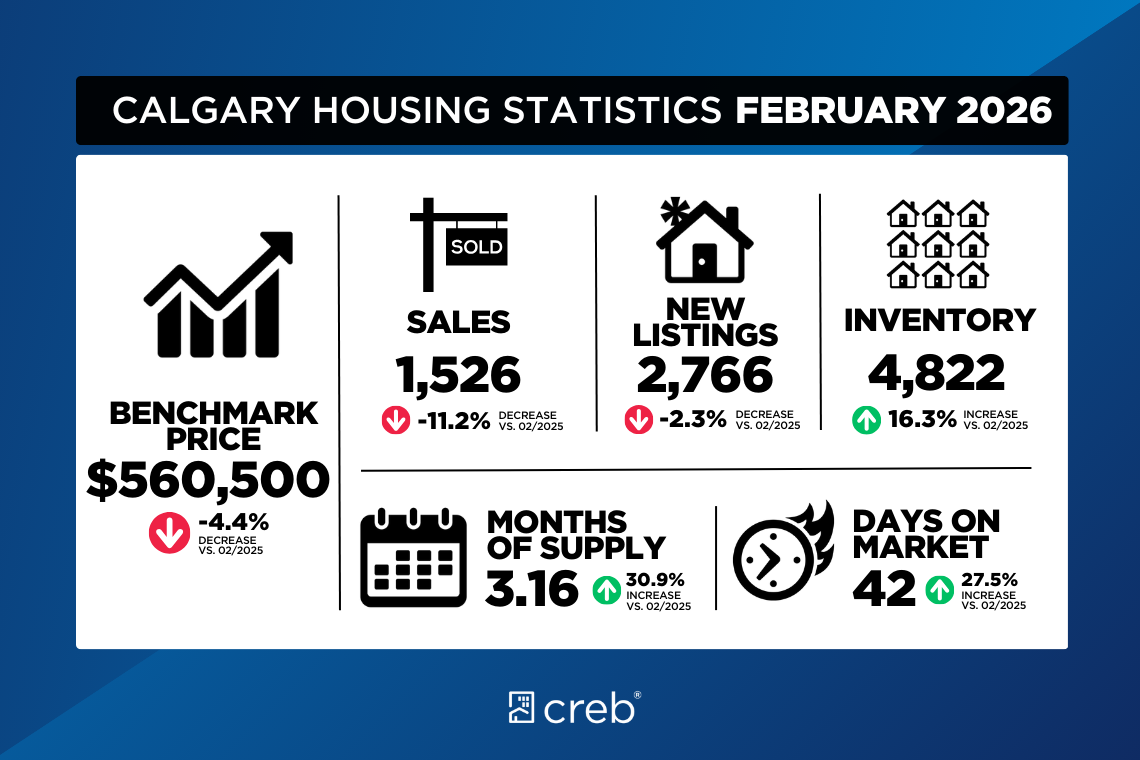
In February, Calgary recorded 1,526 home sales, which is about 11% lower than the same time last year. At the same time, the market saw 2,766 new listings come onto the market. Inventory increased to 4,822 homes available for sale, pushing the city toward a more balanced market overall.
But looking only at the overall numbers doesn’t tell the full story.
The Calgary market today is really two different markets moving at the same time.
On one side, detached and semi-detached homes remain relatively tight, with less than three months of supply in many cases. That means well-priced homes, especially in popular price ranges, can still sell quickly when they hit the market.
On the other side, apartment-style condominiums are experiencing rising supply, giving buyers more options and creating downward pressure on prices in that segment.
This divide is largely the result of two major factors happening at once:
• Strong construction activity, particularly in apartment developments
• Slowing migration growth, which had previously been driving significant housing demand
In fact, nearly 18,000 apartment units are currently under construction in Calgary, with many intended for rental housing. While this helps address long-term housing needs, it also adds supply that can affect the condo ownership market in the short term.
What does this mean for the market?
Despite these differences across property types, the overall Calgary market is currently sitting at about three months of supply, which is considered relatively balanced.
A balanced market means:
• Sellers can still achieve strong results if homes are priced and marketed correctly.
• Buyers may have slightly more negotiating power in some segments.
• Strategy matters more than ever when entering the market.
Another important indicator is price movement. The benchmark price for all residential property types in Calgary is now $560,500. This is 1% higher than January, reflecting typical seasonal gains early in the year. However, prices remain about 4% lower than the same time last year, largely due to price adjustments in the apartment and row housing sectors.
A Market Full of Opportunity, If You Know Where to Look
Think of the Calgary real estate market today like four different lanes of traffic moving at different speeds:
• Detached homes → steady and competitive
• Semi-detached homes → tightening conditions
• Row homes → balanced with growing supply
• Apartments → buyers gaining leverage
Understanding which lane you're in makes a huge difference when making real estate decisions.
For example:
• A seller with a detached home under $700,000 may still see strong demand.
• A buyer looking for a condominium may have more negotiating power than they would have a year ago.
That’s why reading the market at a high level is helpful but understanding the details is where the real advantage lies.
A Question for You
If you were thinking about making a move in the next 12–24 months…
Would you rather buy when competition is high, or when inventory is rising and buyers have more options?
The answer to that question often determines the best timing strategy for entering the market.
In the next section, we’ll take a closer look at February’s market performance, including sales activity, new listings, inventory levels, and what these numbers could mean for the months ahead.
Market Performance
Sales Activity
Calgary recorded 1,526 residential sales, representing an 11% decrease compared to February 2025.
While sales were lower than last year, it’s important to look at why.
The drop in sales was largely driven by a sharp pullback in apartment and row home purchases, while demand for detached and semi-detached homes remained relatively stable.
When demand shifts between property types like this, it often signals that buyers are becoming more selective and sensitive to price, inventory, and interest rate conditions.
Even with the decline in year-over-year sales, Calgary is still experiencing healthy market activity compared to long-term averages, showing that buyers remain active, just more strategic.
New Listings
February saw 2,766 new homes listed for sale across Calgary, which is slightly lower than the same time last year.
However, the composition of those listings is important.
Much of the growth in available inventory came from:
• Apartment condominiums
• Row homes
Meanwhile, supply for lower-density housing such as detached homes under $700,000 remains limited, continuing a trend that has been shaping the Calgary market for the past few years.
This imbalance in supply is one of the key reasons we are seeing very different conditions depending on the property type.
Inventory Levels
Inventory rose to 4,822 homes available for sale in February, which is over 16% higher than the same time last year.
More than half of that inventory now consists of row homes and apartment condominiums, reinforcing the growing supply in those segments.
This increase in inventory pushed the overall market to 3.16 months of supply.
With just over three months of supply, Calgary is now sitting in what economists consider a balanced housing market.
That means the extreme seller conditions seen in previous years are easing, giving buyers slightly more room to negotiate, though demand still remains strong in many areas.
Home Prices
The benchmark price for all residential properties in Calgary reached $560,500 in February.
This represents:
• 1% increase from January 2026
• 4% decrease compared to February 2025
Seasonally, it’s common for prices to rise slightly early in the year after softer activity toward the end of the previous year. That pattern appears to be repeating again in 2026.
However, the price adjustments we are seeing year-over-year are largely due to price declines in apartment-style homes, while lower-density housing such as detached and semi-detached homes have been more stable.
What These Numbers Mean for Buyers and Sellers
When you look at the numbers together, a few important themes emerge:
1. Calgary’s market is stabilizing.
Inventory is rising, which is creating more balance between buyers and sellers.
2. Different property types are behaving very differently.
Detached homes remain tight, while condos are facing growing supply.
3. Strategy matters more than ever.
Pricing, marketing, and negotiation tactics are becoming more important as conditions shift.
A few years ago, simply listing a home could attract immediate offers. Today, success often depends on how well the property is positioned in the market.
A Simple Way to Think About the Market Right Now
Imagine Calgary’s real estate market like a four-lane highway.
Each lane represents a property type:
• Detached homes
• Semi-detached homes
• Row homes
• Apartments
Right now, those lanes are moving at different speeds.
Some are still flowing quickly with strong demand, while others are slowing as supply increases.
Understanding which lane you’re in can make a huge difference in how you approach buying or selling a home.
Sector-Specific Analysis
To really understand what is happening in Calgary’s housing market, it helps to break things down by property type. Each segment of the market is behaving a little differently right now, influenced by supply levels, buyer demand, and price expectations.
Some markets remain competitive, while others are giving buyers more room to negotiate.
Let’s take a closer look.
Detached Homes
Detached homes remain one of the strongest and most stable segments of the Calgary real estate market.
In February, the city recorded 736 detached home sales, which is very similar to the level reported at the same time last year. New listings also remained steady with 1,269 homes entering the market, bringing the sales-to-new-listings ratio to 58%.
Inventory levels did rise slightly, pushing the market to just under three months of supply, which places detached homes in a balanced market territory.
However, the story changes depending on the price range and area of the city.
For example:
• The West district remains one of the tightest markets, with less than two months of supply.
• The North East district is seeing more available inventory, creating softer conditions in that area.
The benchmark price for a detached home reached $734,300 in February, which is over 1% higher than January, though still about 3% lower than the same time last year.
One ongoing challenge in this segment is limited supply for homes priced under $700,000, where buyer demand remains particularly strong.
Semi-Detached Homes
The semi-detached market is a smaller but very active segment of Calgary’s housing market.
February saw 175 sales, alongside 253 new listings, resulting in a sales-to-new-listings ratio of roughly 69%.
These conditions pushed the months of supply down to about 2.4 months, making semi-detached homes the tightest segment in the entire market.
When inventory gets this low, it often supports price stability or even modest gains.
That’s exactly what we saw this month.
The benchmark price rose to $682,200, which is over 2% higher than January and roughly in line with prices from last year.
That said, price trends still vary depending on location.
Some districts , including City Centre, North West, and West Calgary , saw year-over-year price gains, while other areas recorded slight declines.
Overall, this sector continues to benefit from buyers who want more space than a condo but a lower price point than a detached home.
Row Houses
Row homes experienced stronger sales activity in February compared to January, reaching 270 transactions.
At the same time, 491 new listings entered the market, bringing the sales-to-new-listings ratio to about 55%.
While inventory levels did increase, the improvement in sales helped bring the months of supply down from over four months in January to just over three months in February.
That puts the row housing segment closer to a balanced market, similar to the overall Calgary market.
The benchmark price for row homes rose to $423,600, reflecting typical seasonal gains early in the year. However, prices remain about 5% lower than February of last year.
Price changes also vary significantly by district.
Some of the largest year-over-year declines occurred in the North East and East districts, where prices have dropped by more than 10%. Meanwhile, row homes in the West and City Centre districts have seen far smaller adjustments.
Apartment Condominiums
Apartment condominiums are currently the most buyer-friendly segment of the Calgary housing market.
Despite a slight decline in new listings during February, this sector still recorded 753 new listings compared to 345 sales, resulting in a sales-to-new-listings ratio of just 46%.
This imbalance continues to push inventory higher.
By the end of February, there were 1,580 apartment units available for sale, which translated into more than four months of supply.
Higher inventory levels naturally put downward pressure on prices, which is exactly what we are seeing.
The benchmark price for apartment condominiums dropped to $298,600, which is:
• Nearly 1% lower than January
• More than 9% lower than February last year
Supply conditions also vary dramatically across the city.
For example:
• The North East district currently has more than 11 months of supply.
• The South district has closer to four months of supply.
With thousands of apartment units currently under construction across Calgary, this segment may continue to see elevated supply levels in the near future.
For buyers, this can create excellent opportunities, particularly for those entering the market for the first time.
Regional Market Insights
While Calgary remains the center of real estate activity in the region, nearby communities such as Airdrie, Cochrane, and Okotoks continue to play an important role in the broader housing market. Many buyers who work in Calgary choose these communities for lifestyle reasons, affordability, or newer housing options.
Each market, however, has its own supply levels, pricing trends, and buyer demand.
Let’s take a closer look at how these surrounding communities performed in February.
Airdrie
Airdrie continues to see steady activity, though the market has become more balanced compared to the tight conditions seen in recent years.
In February, the market recorded:
• 122 home sales
• 236 new listings
This resulted in a sales-to-new-listings ratio of about 52%.
Inventory levels rose slightly compared to both the previous month and last year, pushing supply levels above long-term averages. Even with this increase, the market is still operating with just over three months of supply, keeping conditions relatively stable.
The benchmark price in Airdrie reached $512,200, which is similar to January but about 5% lower than the same time last year.
A few factors are contributing to this adjustment:
• Increased competition from new home construction
• More supply choices across Calgary and nearby communities
• Buyers having more options than they did during the peak market periods
For buyers, this means greater selection and potential negotiating room, while sellers may need to focus more on pricing and presentation.
Cochrane
Cochrane continues to attract buyers looking for a small-town atmosphere with quick access to Calgary, and February’s numbers show the market settling into more balanced conditions.
During the month, Cochrane recorded:
• 91 sales
• 154 new listings
This brought the sales-to-new-listings ratio up to 59%, helping stabilize inventory levels.
With around three months of supply, the market is considered balanced, similar to the overall Calgary market.
The benchmark price in Cochrane reached $553,500, which is slightly higher than January but still about 3% lower than February of last year.
Much of this price adjustment stems from market shifts that occurred during the third quarter of 2025, when several property segments experienced price pullbacks.
Even so, Cochrane remains one of the most desirable communities for buyers seeking a blend of affordability, lifestyle, and proximity to Calgary.
Okotoks
Okotoks continues to operate under tighter market conditions compared to many surrounding areas.
In February, the market saw new listings outpace sales, causing the sales-to-new-listings ratio to fall below 60%. This helped increase inventory levels slightly.
However, supply remains well below long-term averages, and the market is still operating with under three months of inventory.
Tighter conditions have continued to place upward pressure on prices.
The benchmark price in Okotoks reached $612,300, representing:
• A 2% increase from January
• Prices that are very similar to levels seen one year ago
This makes Okotoks one of the more resilient markets in the region, as limited supply continues to support property values.
What Could Happen Next in the Calgary Housing Market
Real estate markets rarely move in a straight line. They respond to many factors such as migration, construction activity, interest rates, employment levels, and consumer confidence. As we look ahead through the remainder of 2026, the Calgary housing market is expected to continue evolving as these forces shape both supply and demand.
Based on the current February data, several trends are beginning to emerge that could influence the direction of the market over the coming months.
Sales Activity: Likely to Stabilize
While February sales were 11% lower than the same time last year, overall activity remains healthy relative to long-term averages.
One key factor affecting demand is slowing migration into Alberta compared to the rapid population growth seen in previous years. During the past few years, Calgary experienced a surge of people moving from other provinces due to affordability and economic opportunity. As migration levels normalize, demand is also expected to stabilize.
However, Calgary still benefits from several strong fundamentals:
• A growing and diversified economy
• Continued job growth in several industries
• Relatively affordable housing compared to other major Canadian cities
Because of this, sales activity is expected to remain steady throughout 2026, even if it doesn’t match the record pace seen in recent years.
New Listings: Supply is Increasing
Another trend we are beginning to see is an increase in housing supply.
Inventory levels in February reached 4,822 homes available for sale, which is over 16% higher than last year.
Several factors are contributing to this:
1. More homeowners choosing to list their properties as the market stabilizes
2. Higher levels of new home construction entering the market
3. A significant number of apartment units currently under construction in Calgary
In fact, nearly 18,000 apartment units are currently being built, many of which are expected to enter the market over the next few years.
This rising supply is one of the reasons we are seeing more balanced conditions across the market.
Price Trends: Moderate and Segmented
Home prices are likely to move moderately rather than dramatically throughout 2026.
The overall benchmark price for residential homes in Calgary currently sits at $560,500, which is slightly higher than January but still lower than last year.
However, price trends will likely vary depending on the property type.
What This Could Mean for Buyers
For buyers, the market may gradually become more favorable compared to the past few years.
Increased inventory and balanced market conditions may create:
• More choice when shopping for homes
• Less intense bidding competition in some segments
• Greater opportunity to negotiate price or conditions
Buyers who were previously discouraged by extremely competitive markets may find better opportunities emerging this year.
What This Could Mean for Sellers
For sellers, the key will be strategy and preparation.
Homes that are well presented, correctly priced, and professionally marketed can still perform extremely well.
However, the market is moving away from the days when nearly every listing attracted multiple offers within hours.
This means sellers should focus on:
• Accurate pricing from day one
• Strategic marketing and exposure
• Professional staging and presentation
In a more balanced market, the difference between an average listing and a well-executed one can be significant.
A Simple Way to Think About the Market
Imagine Calgary’s housing market like a pendulum.
Over the past few years, the pendulum swung strongly toward sellers due to extremely low inventory and intense demand.
Now it is beginning to swing back toward balance, where buyers and sellers both have opportunities, but success often depends on the right strategy.
A Question to Consider
If the market becomes more balanced in 2026…
Would you prefer to buy before prices potentially rise again, or wait and see how supply and demand evolve?
Understanding the answer to that question can help shape the best real estate strategy for you.
Key Takeaways from the February 2026 Market Report
The February 2026 Calgary real estate market tells a clear story: the market is shifting toward balance, but it is doing so unevenly across different property types and communities.
Overall, Calgary recorded 1,526 home sales in February, which is lower than last year but still reflects healthy activity. Inventory has increased to 4,822 homes available for sale, pushing the market to roughly three months of supply, a level typically considered balanced.
At the same time, the benchmark price for all residential homes sits at $560,500, showing a small month-to-month increase but remaining lower than last year’s levels.
These numbers point to a market that is cooling slightly from the extremely competitive conditions of the past few years but still remains fundamentally strong.
Three Key Themes Emerging in the Market
When we step back and look at the February data, three major themes stand out.
1. The Market is No Longer Moving in One Direction
Different property types are experiencing very different conditions.
• Detached homes remain relatively tight in many price ranges.
• Semi-detached homes have some of the lowest inventory levels in the market.
• Row homes are moving toward balanced conditions.
• Apartment condominiums are seeing rising supply and more buyer choice.
Understanding these differences is critical when deciding when and how to buy or sell a property.
2. Inventory is Gradually Returning
Inventory levels are rising compared to last year, which is slowly giving buyers more options.
However, supply is still limited in some important segments, particularly detached homes priced below $700,000, where demand remains strong.
This means the Calgary market is not shifting into a buyer’s market overall, but rather into a more balanced environment where strategy matters more.
3. Calgary Remains One of Canada’s Stronger Housing Markets
Despite some price adjustments and slower sales activity, Calgary continues to benefit from several long-term advantages:
• A relatively affordable housing market compared to cities like Toronto or Vancouver
• Continued economic growth and employment opportunities
• A steady stream of new residents moving to Alberta
• Strong demand for housing across multiple price points
These fundamentals continue to support long-term stability and growth in the Calgary housing market.
What This Means for Buyers
For buyers, today’s market may present better opportunities than we have seen in several years.
With inventory rising and conditions becoming more balanced, buyers may experience:
• More homes to choose from
• Less intense bidding competition
• Greater opportunity to negotiate price or conditions
However, homes that are well priced and located in desirable communities can still sell quickly, particularly in the detached housing segment.
What This Means for Sellers
For sellers, the market is still healthy, but success depends on preparation and strategy.
Homes that are properly priced, professionally marketed, and presented well can still attract strong interest and sell quickly.
On the other hand, homes that are overpriced or poorly positioned in the market may take longer to sell as buyers now have more options.
This is where the right guidance and marketing approach can make a significant difference.
Looking at the Bigger Picture
Real estate markets naturally move through cycles.
Some years favor sellers.
Some years favor buyers.
Right now, Calgary appears to be entering a phase where both buyers and sellers can succeed, provided they understand the current market conditions and make informed decisions.
And while short-term fluctuations will always occur, Calgary’s long-term outlook remains strong thanks to population growth, economic opportunity, and continued demand for housing.
Every real estate decision is unique.
Whether you’re thinking about buying, selling, investing, or simply staying informed about your home’s value, understanding the market is the first step.
If you would like a personalized analysis of your situation, or if you're curious about what your home might be worth in today’s market, I’d be happy to help.
You can reach me anytime:
Call or Text: 403-809-9386
Schedule a Conversation: PlanWithMike.ca
I’m always here as a resource to help you plan your next move with confidence.
Mike Abou Daher
Realtor®
Real Broker
team@mikeaboudaher.com
(587) 333-6400 - Work
(403) 809-9386 - Mobile

COPYRIGHT © 2020. CREATED
BY MIKE ABOU DAHER.